
Agrivoltaics puts solar panels and farming on the same land, with crops or livestock under raised panels or between widely spaced rows. We design farm-scale agrivoltaic systems that power the farm's pumps and buildings first, with heights and row spacing set by your crop and machinery.
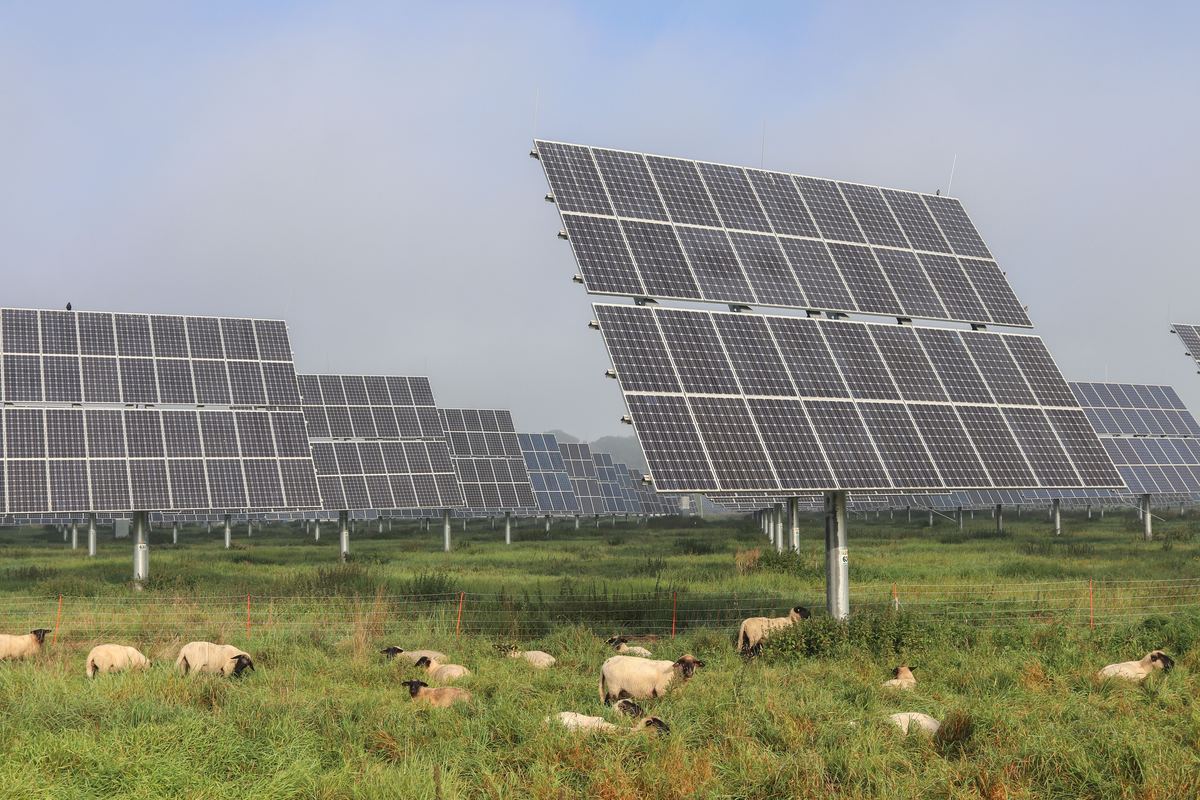
The main agrivoltaic layouts
Raised structures. Panels are mounted high enough for people and machinery to work underneath, typically between two and four metres, or above four metres for full-size tractors and harvesters. They suit vineyards, orchards, horticulture and crops that benefit from partial shade in a Spanish summer.
Interrow layouts. Rows of panels at normal height are spaced widely enough for farming to continue between them. This is the cheapest structure and suits arable crops and grazing, as long as the gap matches the working width of your machinery.
Vertical and tracking systems. Vertical bifacial panels take up a narrow strip and produce in the morning and evening; single-axis trackers can be turned flat or upright to let machinery through or change the shade over the crop. Sheep grazing under trackers is one of the simplest combinations, because the flock keeps the vegetation down.
What Spain is building
Agrivoltaics has moved from pilots to a real pipeline. IDAE's two calls for innovative renewable projects have awarded about €313.8 million to 182 agrivoltaic projects with storage, totalling about 1,038 MW. Around 100 of them use interrow layouts and the rest raised structures. The most common crops are cereals, olives, horticulture and vines, and the Valencian Community and Catalonia account for almost half of the projects.
Most of those are multi-megawatt plants. Only 57 of the 182 are 1 MW or smaller, and that is the size we focus on: systems that serve the farm itself, its pumps, its stores and its processing, with surplus exported or shared with neighbours. Larger schemes we deliver together with a utility-scale construction partner.
CAP payments on agrivoltaic land
Until 2025 farmers risked losing Common Agricultural Policy payments on land with panels on it. Real Decreto 916/2025 changed that from the 2026 campaign: on an agrivoltaic installation, the whole parcel of arable or permanent crop land remains eligible as long as agriculture is still the main activity. Conventional solar parks on farmland are still deducted as unproductive area.
The detailed technical test for "main activity" is still to be set nationally. The most specific reference so far is Catalonia's guideline, which asks projects to keep at least 60% of the original agricultural production and to put no more than 15 to 20% of the surface out of use. We design to that standard unless your region sets a different one, and we document the farming plan so you can show it to your CAP office.
How we design an agrivoltaic system
We start with the farm, not the array. We need to know the crop or livestock, the rotation, the machinery you use and its working widths and heights, how the land is irrigated and where the farm uses electricity. From that we choose the layout, the height and the row spacing, then the shade ratio the crop can take.
The details matter in the field: posts placed so they do not block irrigation lines, cables buried deep enough for ploughing or protected from livestock, and access for spraying and harvest. Where the farm pumps water, we size the system to cover the pumps first, as described on our solar irrigation pumping page, because that is where the output is worth most.
Thinking about panels over a field or a vineyard? Send us the location, the crop and how the farm uses electricity, and we will tell you whether an agrivoltaic layout is worth studying.
Request an assessment ↗Cost and procedures
Agrivoltaic structures cost more per kWp than a standard ground array, because raised frames use more steel and need stronger foundations, and wide row spacing means more cable per kWp. Against that, the land keeps producing a crop and, from 2026, CAP income. We price the structure separately so you can compare layouts on equal terms.
Ground-mounted installations on rural land go through municipal and regional procedures, and environmental assessment where the size or location requires it. Systems above 100 kW also face a different grid and producer route, which our page on large commercial solar systems explains. We confirm the route for your plot before we give you a programme.
Frequently asked questions
Will the panels reduce our crop yield? It depends on the crop and the amount of shade. Some crops lose yield under shade, while vines, berries and many vegetables can cope well or benefit from protection against heat and hail in a Spanish summer. We set the shade ratio from the crop's light needs and show you the expected trade-off.
Can we still claim CAP payments on a plot with panels? From the 2026 campaign, yes, if the installation is agrivoltaic and agriculture remains the main activity on the parcel, under Real Decreto 916/2025. A conventional solar park on the same land would be deducted from the eligible area.
Can sheep graze under the panels? Yes. Grazing is one of the easiest agrivoltaic uses. We raise the lower edge of the panels and protect the cabling so the flock cannot damage it, and the sheep keep the grass down, which saves mowing.
How big a system do you build on a farm? Our focus is farm-scale systems of up to about 1 MW that supply the farm's own pumps and buildings. For larger projects we work with a utility-scale construction partner and remain your point of contact.
Request an assessment
Send us the location, what the electricity is used for, the months you use most and a recent bill or your Datadis data. We will review it and tell you whether a site visit is worthwhile. The first review is free.